

Insights & Reflections
From Comfort to Activation: Art's Evolving Role in Liminal Space
Thursday, June 18, 2026


.svg)
There is a feeling that has no clean name in English. Horror has known about it for decades. Kubrick built an entire film around it with the Overlook Hotel, and a lineage of directors since have used empty corridors, impossible architecture, and spaces stripped of purpose to externalize psychological states their characters can't escape. A24's Backrooms, in theaters now, is the latest and perhaps most literal version: a man so lost in his own failures that an infinite maze of yellow-walled, fluorescent-lit corridors becomes, perversely, a place he'd rather stay. The internet gave this feeling a name — liminal space — and now it's a cultural conversation. Which makes it a design conversation too.
Why These Spaces Actually Unsettle Us
The psychological mechanics beneath this are worth unpacking, because they're more specific than simply "empty = creepy."
Jay Appleton's Prospect-Refuge Theory proposes that humans have an evolved preference for environments where they can see without being seen, an inheritance from ancestral landscapes where that combination meant safety. Liminal spaces violate this on both counts. A long institutional corridor offers unobstructed sightlines with nowhere to take cover. Your nervous system reads it as exposure even when nothing is visibly threatening.
Then there's what we might call the spatial uncanny: the horror not of something alien, but of something almost-right. The carpet. The ceiling tile. The fluorescent hum. Your brain retrieves a hundred memories of spaces like this, school hallways, office corridors, mall backrooms, then notices the wrong thing: the absence of people, of purpose, of permission to be there. Context has been stripped and only the shell remains.
There's also a generational dimension. For people who grew up in the 80s, 90s, and early 2000s, these anonymous transitional interiors are the landscape of childhood: waiting rooms, pedways, food court atria. The liminal space aesthetic generates nostalgia and unease simultaneously, inseparably. That combination is precisely what makes it so shareable and so sticky.
Marc Augé named these spaces non-places back in 1992: airports, motorways, hotel lobbies, the corridors between things. Locations that hold no identity, no history, no relation. You move through them. They do not remember you. The internet's liminal aesthetic, decades later, is essentially a mass emotional response to having spent entire lives inside Augé's non-places.
Art's Answer: Comfort First
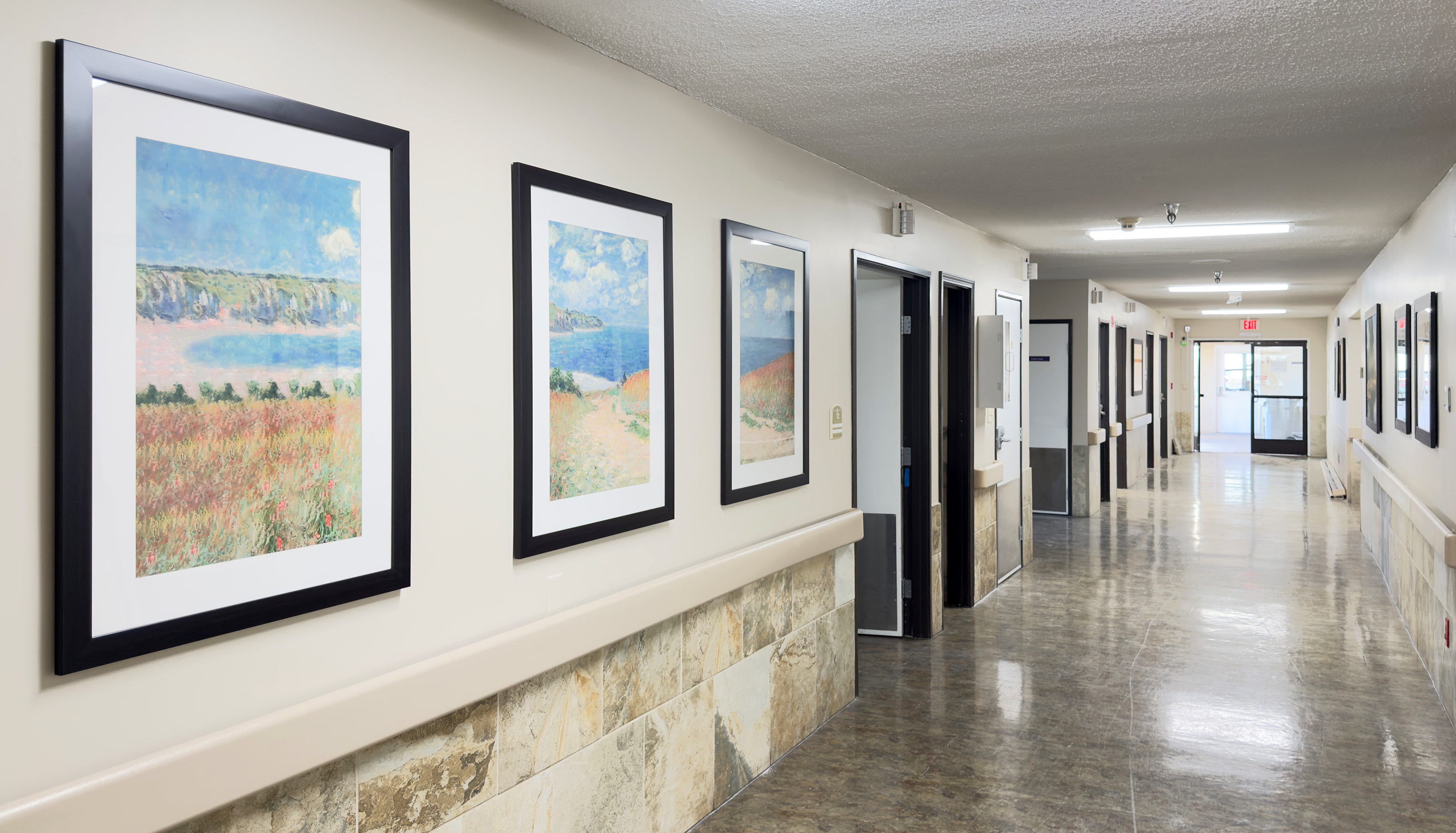
For a long time, design's response to all of this was therapeutic. If transitional spaces made people anxious, the intervention was softness: a mural of a landscape, a print of warm color, something to look at that wasn't a blank wall.
The research supports this instinct. Studies going back to Roger Ulrich's landmark 1984 work found that surgical patients with views of natural scenes recovered measurably faster and needed less pain medication than those facing bare walls. Subsequent research confirmed that nature imagery consistently reduces cortisol, lowers navigational anxiety (the low-grade stress of not knowing where you are or how long you'll be there), and creates what psychologists call positive distractions, pulling an anxious mind away from worst-case spiraling.
The therapeutic art tradition is real and it matters. But it operates on a specific assumption: that the job of art in a liminal space is to deny what the space is. To import a meadow, a coastline, a forest into a corridor that is, by definition, none of those things.
That assumption is now being tested.
From Comfort to Activation
Something has shifted in environmental graphic design, and the momentum behind it is accelerating. Where therapeutic art sought to ease the discomfort of transitional spaces by making them feel like somewhere else, a newer school of thinking asks a different question: what if the passage itself became the experience?
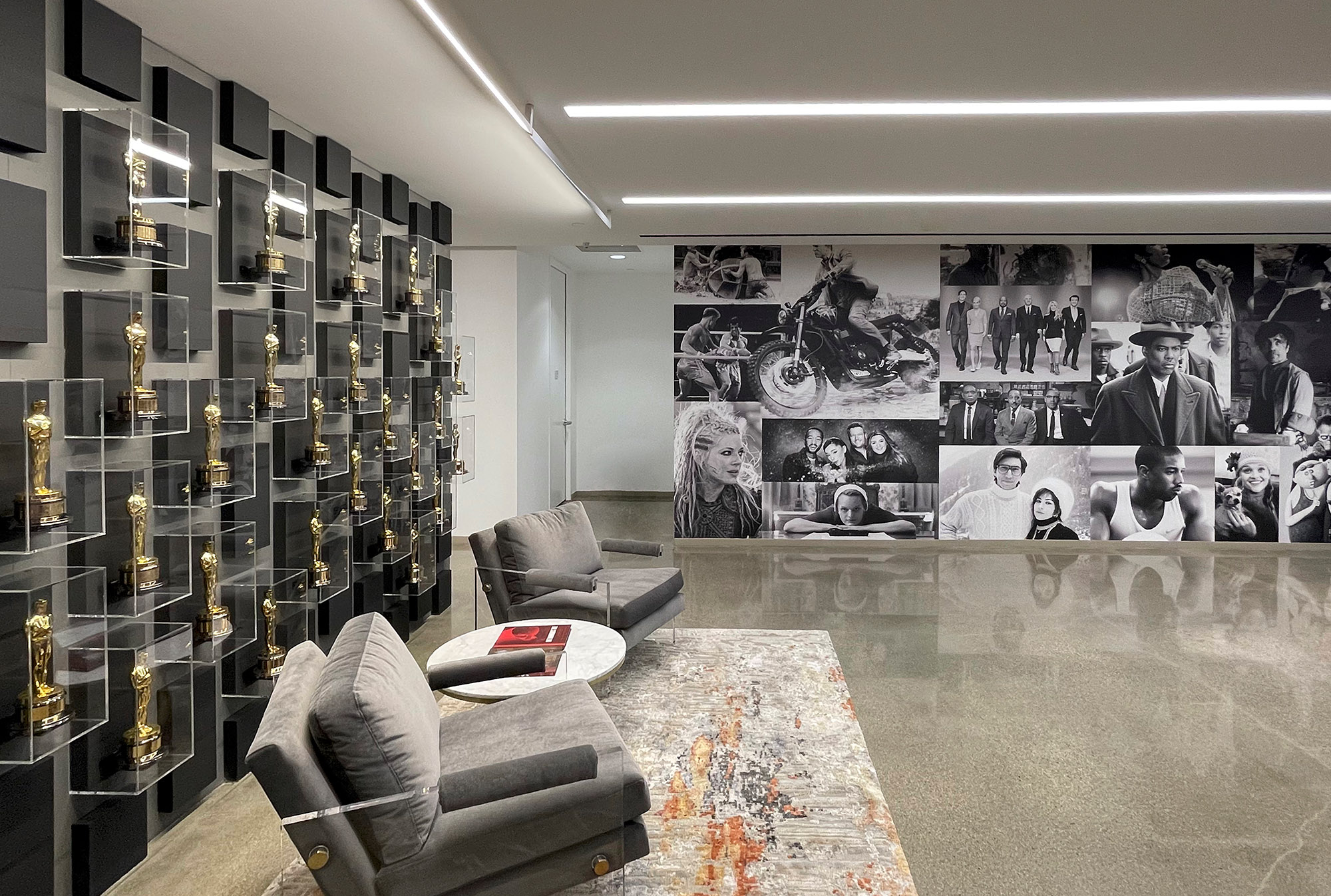
Supergraphics are bold, large-scale graphic designs applied directly to architectural surfaces, walls, floors, and ceilings, and they have existed as a design tool since the 1970s. But their application has evolved from signage-adjacent utility toward something far more psychologically intentional. Today's experiential designers are thinking not just about wayfinding but about emotional tone, narrative arc, and the way a space can unfold as a story while you move through it.
The difference between the therapeutic model and the activation model is the difference between art that asks you to restand design that asks you to engage. A hospital mural of a lakeside landscape invites the eye to settle somewhere safe. A bold environmental graphic that wraps a stairwell in typographic storytelling, or uses color and scale to signal the shift between a clinical zone and a recovery wing, does something else entirely: it makes the passage itself meaningful. It gives the non-place a place-ness it didn't have before.
This is, in a sense, the design antidote to what Backrooms and The Shining are diagnosing. The horror of those spaces lies precisely in the absence of activation: functional environments stripped of meaning, corridors that go nowhere, identical rooms with no hierarchy and no end. Thoughtful environmental graphic design answers that horror not by pretending the corridor is a garden, but by insisting the corridor is something worth moving through.
A Necessary Calibration
None of this means activation always works, or that bolder is better. Research on art in clinical and transitional environments is consistent on one uncomfortable point: poorly chosen visual stimulation doesn't produce neutral outcomes. It can produce agitation. Abstract imagery misaligned with context, visual complexity that overwhelms rather than orients, bold graphics applied without psychological consideration — none of these are better than a blank wall. In some documented cases, they're worse.
The activation model doesn't abandon the evidence base. It has to be built on it. The question isn't whether to engage people in transitional spaces. It's what you want them to feel, and whether the design choices you're making actually produce that feeling in the people moving through them.
That requires moving beyond aesthetic preference into something more rigorous: understanding the population, the psychological work the space needs to do, and the specific design language most likely to do it well.
What the Corridor Is Actually Asking
Backrooms became a cultural phenomenon because it named something people already felt but couldn't articulate: the specific dread of spaces that exist only to be passed through, and the psychological cost of getting stuck in one. That resonance isn't incidental. It's diagnostic.
The same spaces that horror has spent decades weaponizing are spaces that designers, wayfinding consultants, and art programs interact with every day. The airport. The hospital corridor. The office lobby. The parking structure stairwell. We have tended to treat them as afterthoughts, spaces to be tolerated between real destinations, or at best as walls to be softened.
But the cultural conversation around liminal spaces suggests something more interesting is available. People are drawn to these in-between places. They photograph them, post them, argue about them, and make horror films about them. There is something in the human psyche that wants to reckon with the threshold, to examine what it means to be between one thing and the next.
Design, and the art within it, has the tools to participate in that reckoning. Not by eliminating the uncanny quality of transitional space, but by meeting it with intention. By deciding what a corridor is for, beyond getting from one room to another, and building an experience worthy of the passage.
The waiting room was always doing psychological work. We're only now building a design language sophisticated enough to do it on purpose.
TKOart works with architects, designers, and institutions to develop art programs that treat the built environment as a psychological variable, not a backdrop. Whether the context is healthcare, hospitality, corporate, or civic, the question is always the same: what should this space do for the people inside it?

More Posts
Related Articles

Harnessing Color Psychology in Healthcare Art
Learn how strategic color choices can transform clinical spaces into havens of comfort and support.

Exploring the Benefits of Corporate Art Consulting
Using art to create a professional workplace and enhance office layout for a positive and inspiring environment.
The Intricate Allure of Texture in Abstract Art
The transformative power of texture in our online exhibition, featuring the abstract works of Father Bill Moore.
About Us
TKOart is a full-service art consultancy with over 30 years of experience, dedicated to bringing your fine art needs to life.