

Featured Artists
Remembering Yaacov Agam: The Artist Who Taught Us That Art Should Move
Thursday, June 25, 2026


.svg)
On June 21, 2026, the art world lost one of its last great pioneers of the post-war avant-garde. Yaacov Agam, the Israeli sculptor widely regarded as the father of kinetic art, died in Paris at the age of 98, just weeks after receiving Israel's highest cultural honor, the Israel Prize for Visual Arts.
TKOart doesn't deal in Agam's work, but his influence runs through so much of what excites us about art today, particularly the idea that a piece isn't finished until someone experiences it. We wanted to take a moment to look back at his career and consider why that core idea feels more relevant now than ever.
From Rishon LeZion to the Heart of the Paris Avant-Garde
Born Yaacov Gibstein in 1928 in Rishon LeZion, in what was then Mandate Palestine, Agam was the son of a rabbi and kabbalist. Jewish thought and mysticism instilled during childhood, stayed with him for life. He often described his art as an extension of a Jewish worldview built on change, renewal, and multiplicity of perspective.
He trained at the Bezalel Academy of Art and Design in Jerusalem under Mordecai Ardon, then moved to Zurich in 1949 to study under Bauhaus veteran Johannes Itten. By 1951 he had settled in Paris, the city that would remain his home for the rest of his life.
It was there, in 1955, that Agam helped change the course of modern art. At the landmark Le Mouvement exhibition at Galerie Denise René, he showed alongside Victor Vasarely and Jesús Rafael Soto, presenting work that looked different depending on where the viewer stood. It was an early, electric statement of an idea he would spend the next seven decades refining.
Art as a Living Process
Agam rejected the notion that a painting or sculpture should hold one fixed, "correct" appearance. For him, a work only truly existed in the moment a viewer moved past it, around it, or in front of it. He called this principle the "fourth dimension," a fusion of movement and perception that kept a piece in a constant state of becoming.
That idea produced some of the most ambitious public art of the 20th century:
- Double Metamorphosis III (1965) and his design for the antechamber of Georges Pompidou's private apartments at the Élysée Palace (1972–74), now permanently installed at the Centre Pompidou
- The Fontaine Monumentale at La Défense in Paris (1975)
- The Fire and Water Fountain at Dizengoff Square in Tel Aviv (1986), still one of Israel's most recognizable public artworks
- "Agamographs," his signature print technique using barrier-grid animation, so the image transforms as the viewer walks past it
- A 32-foot Hanukkah menorah at Fifth Avenue and 59th Street in New York, recognized by Guinness World Records as the largest in the world
- The New Orleans Holocaust Memorial (2003), nine aluminum panels designed to evoke a journey from horror toward revival
He also designed the trophy for the 1999 Eurovision Song Contest. In 2009, at age 81, he created Peaceful Communication with the World, a set of nine towering hexagonal pillars for the World Games in Kaohsiung, Taiwan. Decades into his career, he was still building at monumental scale.
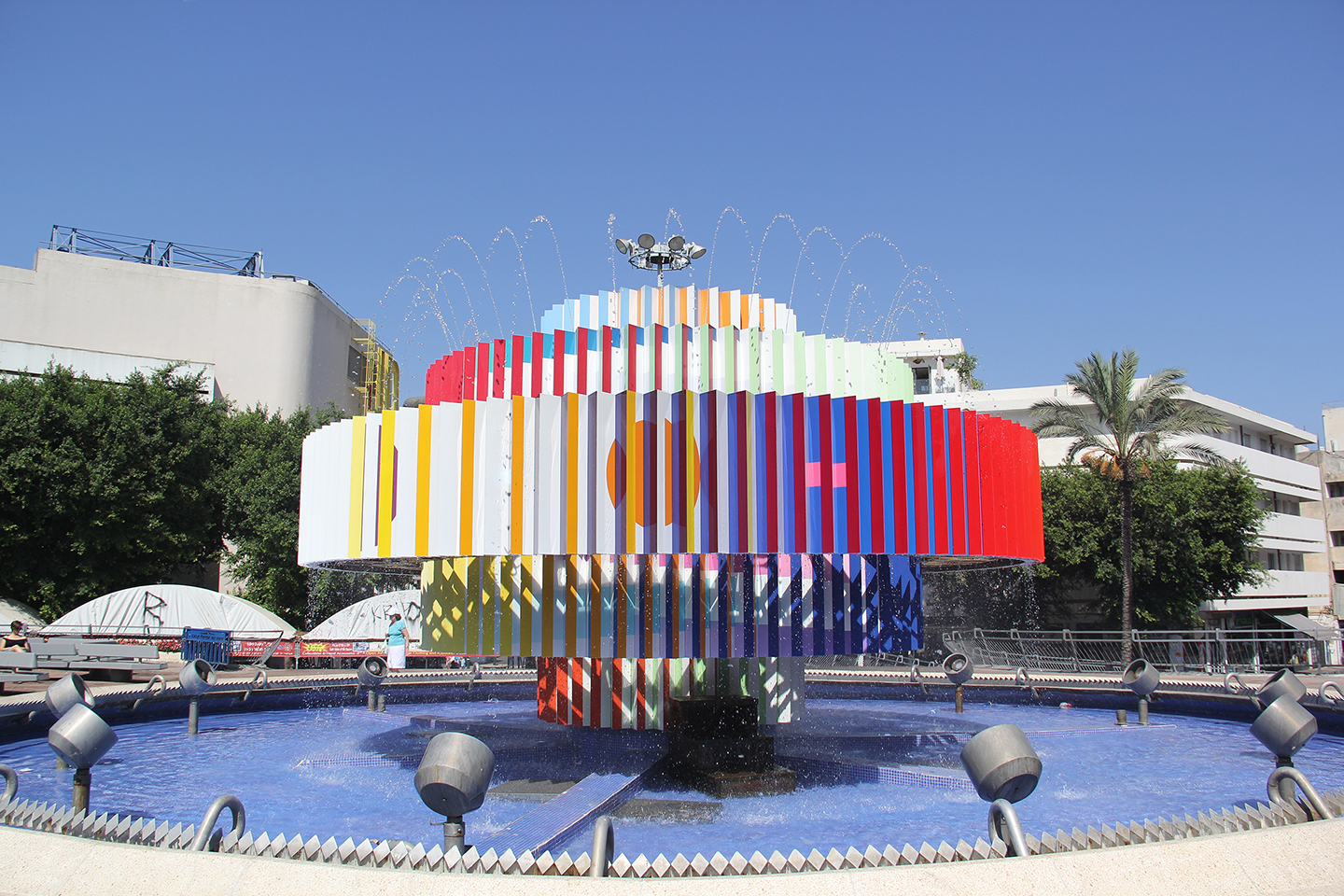
A Legacy That Anticipated Where Art Was Headed
It's worth noting how far ahead of his time Agam really was. Long before "interactive" and "immersive" became buzzwords in galleries, museums, and experience design, Agam had already built a body of work that refused to function without an audience. A static photo of an Agam piece never quite tells the story. You had to be there, moving, for it to mean anything.
That conviction feels strikingly current. The last decade has seen a surge of interest in experiential and participatory art: installations that respond to where you stand, environments that change as you move through them, public spaces designed around interaction rather than observation. None of that owes its existence to Agam alone, but he was making the case for it decades before the rest of the art world caught up, back when most galleries were still committed to the idea of a fixed, frame-bound image.
That's the throughline worth remembering. Long before technology made "interactive" easy, Agam made the argument that it was necessary. Art, in his telling, is something you complete, not something you simply view.
Rest in peace, Yaacov Agam (1928–2026).

More Posts
Related Articles

Harnessing Color Psychology in Healthcare Art
Learn how strategic color choices can transform clinical spaces into havens of comfort and support.

Exploring the Benefits of Corporate Art Consulting
Using art to create a professional workplace and enhance office layout for a positive and inspiring environment.
The Intricate Allure of Texture in Abstract Art
The transformative power of texture in our online exhibition, featuring the abstract works of Father Bill Moore.
About Us
TKOart is a full-service art consultancy with over 30 years of experience, dedicated to bringing your fine art needs to life.