

Healthcare & Healing Environments
Art and Wayfinding in Memory Care: Start With Your Care Team
Tuesday, November 3, 2026


Before choosing a single piece of art for a memory care unit, ask the care team one question: Where do you find yourself redirecting residents?
Staff know the answer without thinking. It's the corner where residents stop and look around, the junction where someone needs a gentle nudge, the corridor that three people walk down every afternoon in search of a room that isn't theirs. Collect those observations and you have something no floor plan shows: a practical map of where residents have the most difficulty finding their way.
Start at the Crossroads
Residents often slow down at crossroads, where a route splits and a decision has to be made. In a small 2025 observation of two Dutch dementia wards, residents paused, looked around, and received guidance from staff primarily at these points.
These moments are worth examining before deciding what to install. The researchers raise the possibility that a location offers residents too little information, or too much competing information. Depending on the spot, the answer is either a clear cue or fewer elements competing for attention. The care team’s observations help identify where to look, and healthcare art consultants can help translate those observations into what belongs there, based on what residents can already see.
Art Can Help a Corridor Become a Place
As dementia progresses, building a mental map of a space gets harder, which makes recognizing familiar places more important. A corridor that looks like every other corridor gives residents little to tell it apart from the rest. Signs help some residents, but in a UK study of older people with memory difficulties in an independent-living retirement community, many said signs were meant to help yet could not recall the last time they had stopped to read one.
Layout plays a major role in wayfinding, but by the time an art program begins, the floor plan is usually set. Art is one of the elements a design team can still shape. A distinctive image at the right location can give a corridor an identity of its own, a place residents learn to recognize and find again.
What Makes a Piece Work as a Landmark
A 2016 review of cue research found early evidence that colorful, familiar, and personally meaningful cues help people with Alzheimer's disease find their way when placed at key decision points and near residents' rooms. The UK study points the same direction: residents favored artwork that felt distinctive and relevant over artwork that felt generic. Three principles follow.
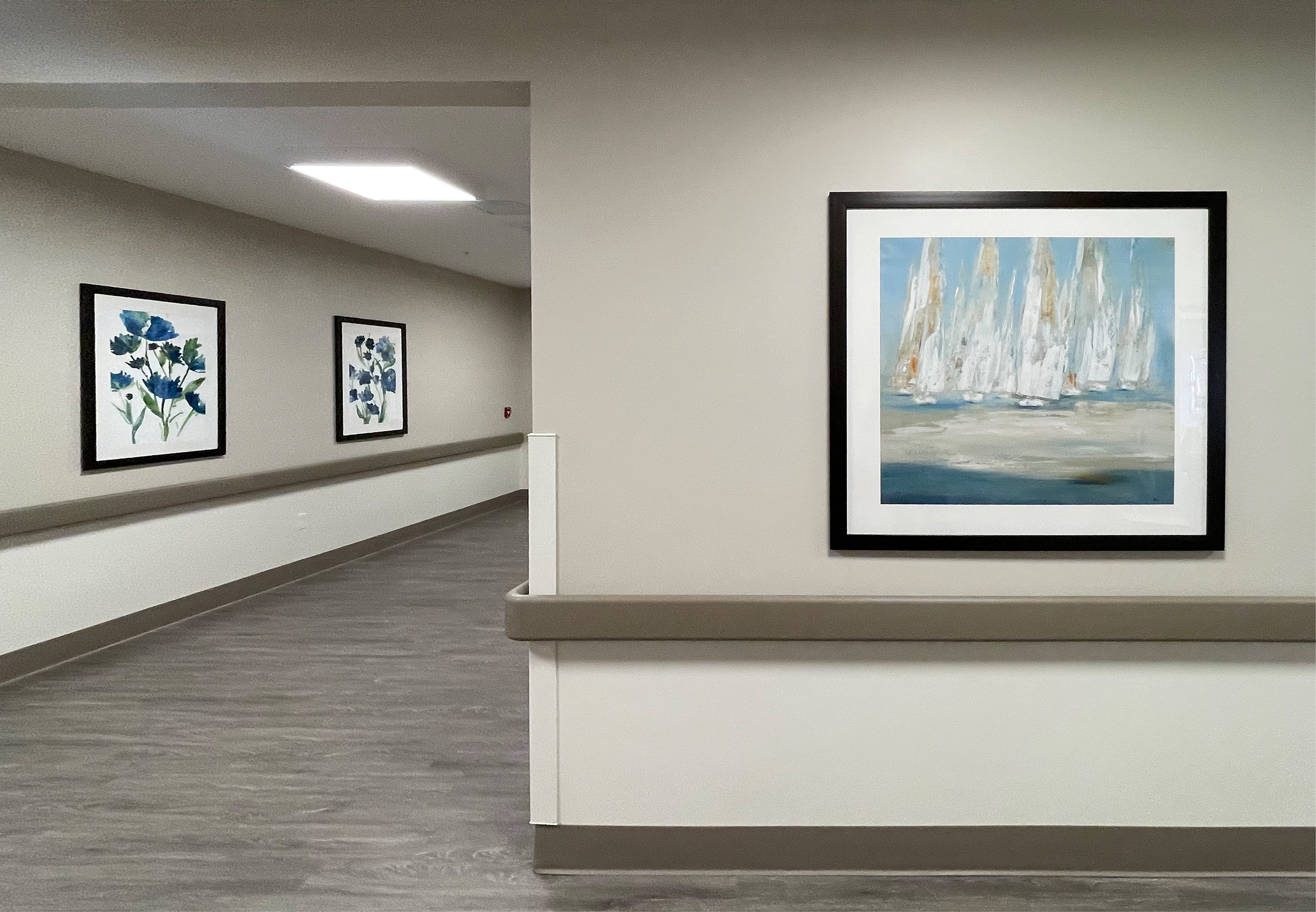
Distinct. Art serves as a landmark when it has an identity of its own. Subject, color, and composition set one piece apart from the next and give residents something to name and remember: the hallway with the harbor photograph, the lounge with the orchard painting. Rather than repeating similar images throughout a unit, curate pieces that each stand apart while still belonging to one coherent environment.
Meaningful. The pictures residents in the UK study praised were local scenes of the surrounding town. Residents found them more memorable, and they gave people something to talk about. Local photography and archival imagery are good ways to bring that familiarity and sense of place into a unit.
Placed where decisions happen. A cue is most useful where a resident needs to orient. The crossroads the care team identifies are logical places to start, as are corridor ends that offer a clear point of reference. Research also suggests older adults find it easier to use a landmark as something to head toward than as a cue for remembering a particular turn.
Where Well-Meaning Art Goes Wrong
These are common defaults, and each can work against residents.
A gallery wall at the junction. A cue has to be noticed to work. The Dutch researchers ask whether a reference point can stand out among everything else in view, from door colors and notice boards to handrails and safety signage. Give one piece room to stand out, with calm walls around it.
Look-alike pieces. A picture is easier to use as a landmark when it can be named. An instruction like "turn at the waterlily picture" stops working if several pictures feature waterlilies. The UK researchers, drawing on earlier work, note that multiple similar pictures can make individual landmarks harder to distinguish. Nature imagery can still be appropriate, but each piece needs a character of its own.
Realistic illusions. Realistic painted scenes can be mistaken for the objects or spaces they depict. The University of Stirling's dementia design centre advises against trompe l'oeil, including photographic murals depicting vistas, doors, and windows, and recommends familiar framed artwork instead.
At the Door
Doors offer a different kind of recognition. Photographs, name signs, and memory boxes chosen with residents and families can help make a room feel identifiable and personal. Research on whether these cues help residents find their own rooms is mixed, so they are worth trying and watching, not counting on. For an art program, that means leaving room for personal cues and keeping the surrounding artwork from competing with them.
How a Wayfinding-Minded Art Program Works
Taken together, the research points to a straightforward order of work: learn where residents struggle, choose pieces they can recognize, place and install them where they help, and check back afterward.
Discovery with the care team. The program starts with the people who know the unit best. Their observations show where cues could help most and where the environment is already creating confusion.
Curation. Distinct, familiar, meaningful pieces, each with an identity of its own.
Placement. Artwork coordinated with the unit's layout, with decision points and corridor ends first in line.
Installation. Mounting hardware, durable finishes, and installation methods that meet the requirements of a healthcare environment.
Follow-up. After installation, the care team's observations are revisited. Changes in where staff need to redirect residents can inform adjustments, even when the effect of the art itself can't be isolated.
A memory care art program should do more than make a space feel welcoming. It should give residents places they can recognize. That starts with the question that opens this post: where do you find yourself redirecting residents?
TKOart works with healthcare teams and design professionals to develop art programs that bring these considerations together, from initial curation through placement and installation, including memory care communities such as those in our work with Generations Healthcare. If you're planning or refreshing a memory care community, contact TKOart to discuss an art program tailored to your facility.

More Posts
Related Articles

Harnessing Color Psychology in Healthcare Art
Learn how strategic color choices can transform clinical spaces into havens of comfort and support.

Exploring the Benefits of Corporate Art Consulting
Using art to create a professional workplace and enhance office layout for a positive and inspiring environment.
The Intricate Allure of Texture in Abstract Art
The transformative power of texture in our online exhibition, featuring the abstract works of Father Bill Moore.
About Us
TKOart is a full-service art consultancy with over 30 years of experience, dedicated to bringing your fine art needs to life.